

News and press
Stay inspired.
Helpful tips, stories, and news from the Vulnerability Registration Service.
Latest
CSA Webinar: featuring The Vulnerability Registration Service, data insights and the future of joined-up support
How can organisations across the credit and collections sector better identify, understand and support customers experiencing vulnerability, while reducing the need for people to repeatedly share sensitive information about their circumstances? This webinar explores the Vulnerability Registration Service (VRS), the cross-sector, “tell us once” service helping consumers communicate their vulnerability information and enable participating organisations to respond with greater understanding and appropriate support.
VRS Autumn 2026 Update
We look at the insights VRS data can provide to local authorities, public services and businesses, helping them build a better understanding of the people and communities they serve. We also share news of our partnership with iFAST Global Bank and highlight our recent Vulnerability in Focus webinar, hosted by the Credit Services Association.
More news and articles
2026
2025
- 5 November 2025Vulnerability Registration Service Launches Consumer Portal Support Network
- 22 September 2025Why Enforcement Needs to Embrace Shared Vulnerability Data
- 28 August 2025Embedding the Consumer Duty
- 26 August 2025VRS supports a national water social tariff
- 26 August 202553% of vulnerable consumers identify communication as a challenge
- 22 May 2025Vulnerability Registration Service launches new feature to help protect vulnerable unpaid carers in the UK
- 13 May 2025Vulnerability Data Sharing in the UK: A VRS Perspective
- 17 February 2025It’s so easy to access our data: through our API or our new Client Portal
2024
2023
- 28 November 2023Burnley Savings and Loans has joined the Vulnerability Registration Service
- 7 August 2023IE Hub: the ultimate solution to support customers managing their money effortlessly
- 7 July 2023IncomeMax: helping people claim the money they’re entitled to
- 26 June 2023Kent County Council & VRS
- 7 June 2023The Energy Crisis is Far from Over
You’re in control, always.
Your information belongs to you. Register safely with VRS, knowing your data is handled with care, compliance, and complete transparency.
CSA Webinar: featuring The Vulnerability Registration Service, data insights and the future of joined-up support
How can organisations across the credit and collections sector better identify, understand and support customers experiencing vulnerability, while reducing the need for people to repeatedly share sensitive information about their circumstances?
This webinar explores the Vulnerability Registration Service (VRS), the cross-sector, “tell us once” service helping consumers communicate their vulnerability information and enable participating organisations to respond with greater understanding and appropriate support.
VRS Autumn 2026 Update
Welcome to the Autumn 2026 edition of the VRS newsletter.
With recent Government announcements bringing renewed attention to unpaid care and the challenges faced by those supporting family members and friends, we felt this was a timely opportunity to share more about the journey VRS has been on, what we have created and why our work is so relevant.
Unpaid carers are an important part of this story, and we have included some content exploring the need for greater recognition and support. We also want to highlight how VRS already provides a practical way for people to register their circumstances, record the support they need and share relevant information with organisations they trust.
In this edition, we look at the insights VRS data can provide to local authorities, public services and businesses, helping them build a better understanding of the people and communities they serve. We also share news of our partnership with iFAST Global Bank and highlight our recent Vulnerability in Focus webinar, hosted by the Credit Services Association.
There is a great deal happening across VRS, and we hope this update gives you a useful insight into our progress, our partnerships and the opportunities ahead.
The VRS Team

A voice for unpaid carers –and a solution that already exists
From the CEO | Why lived experience must lead to practical action

Over the last couple of months, we've seen various government announcements, followed by plenty of press and media coverage and commentary, that underline exactly why we founded the Vulnerability Registration Service ten years ago. The cost of living, financial resilience and reducing homelessness are just a few examples.
But what resonates most loudly with me at the moment is the growing focus on unpaid care.
Anyone who has seen my LinkedIn posts or heard me speak will no doubt have heard me bang on about the realities of being an unpaid carer. I make absolutely no apology for that. Unpaid carers simply do not have a strong enough voice. Quite frankly, most are too overwhelmed and swamped by the reality of what they do every day to have the time or energy to start shouting about the unfairness of their situation.
You cannot walk in someone else's shoes, but two things have happened over the last couple of weeks that might help illustrate the raw reality of unpaid care.
The first was a rare day out.
I managed to sneak myself a very rare day out to celebrate a big birthday for two of my oldest friends.
Leaving the house is a military operation for unpaid carers. In my circumstances, a member of my family needs to be at home at all times, but they cannot undertake everything I do. This means paying professional carers to cover some of the more, shall we say, delicate tasks.
These tasks don't necessarily take long, but you often have to employ professional carers for a minimum of an hour, even when the actual task takes a fraction of that time. For me to be able to leave the house for eight hours meant paying for two hours of professional care. The cost? £82.
I share that figure to put it into context. Carer's Allowance is £86.45 a week.
Think about that for a moment. Two hours of professional care to enable someone to leave the house for a few hours costs almost an entire week's Carer's Allowance.
The second was a mistake I made myself.
I forgot to reorder part of a prescription. Fortunately, it wasn't something that was immediately life-threatening, although it easily could have been.
I was appalled with myself. But the reason I was so horrified was the realisation that, if I get something wrong, the consequences can potentially be fatal.
Unpaid carers are quite simply responsible for somebody else's life. That can mean administering medication, making sure someone is fed and hydrated, and managing all the other day-to-day things that another human being relies on them to do.
There isn't necessarily a family member, district nurse or doctor checking that everything is being done correctly, or whether something has been forgotten. That responsibility rests with one person, often 24 hours a day.
It doesn't matter whether you're exhausted, struggling with your own mental health or physically unwell. The responsibility doesn't go away. Whether you manage to escape the house for a few hours or not, somebody remains completely reliant on you. That is always at the forefront of your mind.
Frustration is one of the strongest emotions unpaid carers experience.
And one of the things that feeds that frustration is listening to or reading other people's thoughts about what unpaid carers need, how they feel and what should be done – particularly when those opinions come from people who have never been in that position.
Talk and analysis are cheap, especially when delivered at arm's length, however well-intentioned. What is needed is acknowledgement, understanding and, above all, action.
This is one of the reasons VRS exists.
We want to give unpaid carers something of a voice. We want to enable the organisations providing services to them to understand their circumstances and respond appropriately.
That means recognising that an unpaid carer may be severely financially impacted because they have had to give up work. Their mental and physical health may be suffering. They are time poor, under pressure and effectively juggling the management of two lives – their own and the life of the person they care for.
VRS provides a practical mechanism to communicate all of this.
We have a specific Unpaid Carer flag, alongside a comprehensive range of other vulnerability flags that allow individuals to describe the additional challenges they face. Importantly, we also allow people to record the support and outcomes they need from the organisations they deal with.
So an unpaid carer can communicate that they are financially struggling, that their health is suffering, that they have limited time, that they need direct telephone contact or that they require a particular type of support.
This is about much more than simply identifying someone as an unpaid carer. It is about helping organisations understand what being an unpaid carer actually means for that individual.
We also recognise that, for every unpaid carer, there is often another vulnerable person who is unable to communicate their own circumstances. Where the appropriate authority exists, VRS allows carers and other authorised representatives to register their loved ones too.
And we are taking this further.
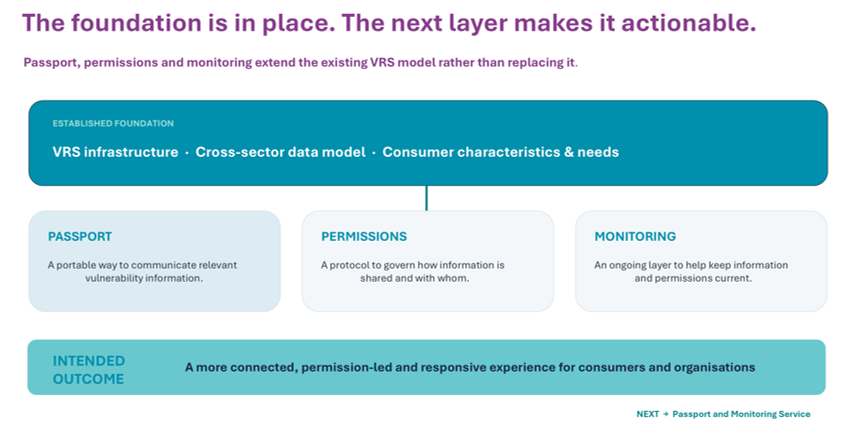
We have built the VRS Vulnerability Passport, which will include functionality enabling individuals to authorise carers to act on their behalf, supported by fully auditable permissions. This is an important development for people who need someone else to help them communicate their circumstances and manage their interactions with service providers.
Here is what I find particularly frustrating.
VRS is not an aspiration, a policy proposal or another idea waiting to be developed. The core service is built and operational. We already have the means to identify unpaid carers, capture the wider circumstances affecting them and communicate the support they need to participating organisations.
The hard part has been done. The model exists. The technology exists. The opportunity exists. Yet we continue to see discussions, commentary and proposals about the need to do more for unpaid carers, while a practical solution that can help is already available.
At some point, we have to move beyond talking about what needs to happen and start making it happen. The biggest obstacle now is not a lack of technology or a lack of a solution. It is prevarication.
Unpaid carers don't need another report telling them how difficult their lives are. They need to be recognised, understood and supported. And unpaid care is just one example of the many circumstances VRS is designed to address. Financial difficulty, mental and physical health, disability, bereavement, accessibility and many other aspects of vulnerability all deserve the same recognition and understanding.
VRS can help make that happen. And I would really like to see more organisations step forward and be part of the solution.
Welcoming iFAST Global Bank
Another step towards more inclusive, customer-centred banking

A partnership built around a simple principle: customers should be understood as individuals, with circumstances and support needs that may not be visible through their account activity alone.
We are delighted to highlight the partnership between iFASTGlobal Bank and the Vulnerability Registration Service (VRS). It reflects a shared commitment to recognisingcustomer vulnerability and supporting more inclusive banking experiences.
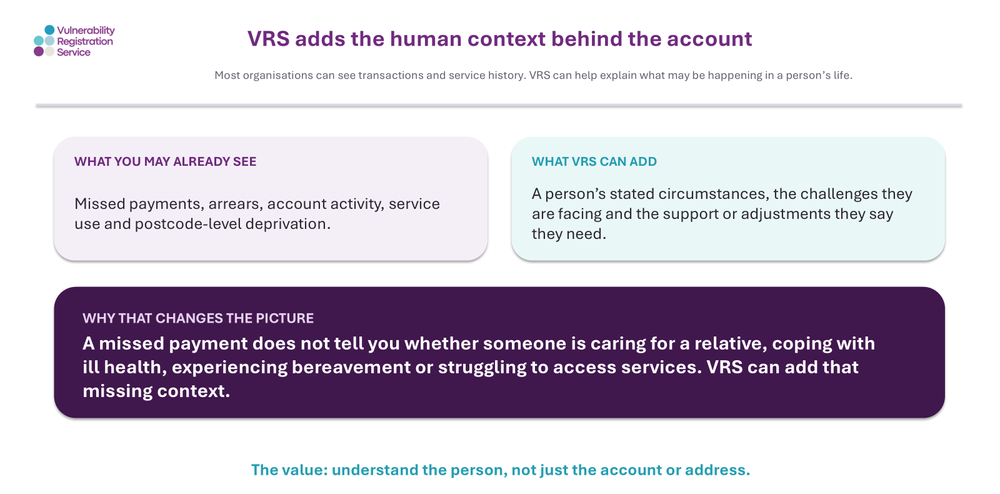
For many people, vulnerability is not a single issue. Financial difficulty may sit alongside caring responsibilities, health challenges, bereavement, disability or a significant change in personal circumstances. These factors can affect how someone is able to engage with a financial organisation.
VRS provides a way for individuals to record relevant circumstances and the support they would like from organisations. Where information is shared under the appropriate permissions and arrangements, this can give participating organisationsadditional context to inform their customer interactions.
That context matters. It can help an organisationconsider clearer communication, appropriate contact routes, additional time to make decisions and a more sensitive approach to discussing a customer's needs.
The partnership also speaks to the wider direction of travel under the FCA's Consumer Duty: understanding customer circumstances and using that understanding to support good outcomes. VRS is not a substitute for an organisation'sown responsibilities or professional judgement; it is an additional source of customer-led information that can help inform them.
We are pleased to see organisationsrecognisingthe value of a more joined-up approach. We look forward to seeing how this partnership develops and to working with more financial services providers who want to make vulnerability recognition more practical and meaningful.
WHAT THIS MEANS FOR CUSTOMERS
A better-informed conversation, less need to repeat difficult circumstances, and a greater opportunity for the organisation to respond in a way that reflects the customer's needs.
Vulnerability in Focus : The role of data insight in joined-up support
How can organisations use vulnerability data to better understand the people they serve and deliver more effective, joined-up support?
That was the subject of VRS’s Vulnerability in Focus webinar, hosted by the Credit Services Association (CSA).
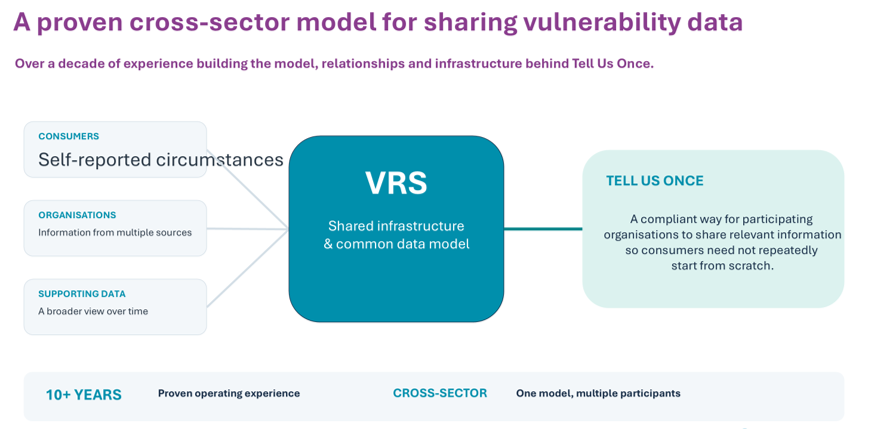
The session explored how the Vulnerability Registration Service (VRS) is helping to change the way organisations identify, understand and respond to vulnerability — and how better use of data and insight can support more informed decisions.
A key focus was the development of VRS’s Passport, Permissions and Alert Service, designed to help people share relevant information about their circumstances and support needs with organisations they trust, with appropriate permissions and safeguards.
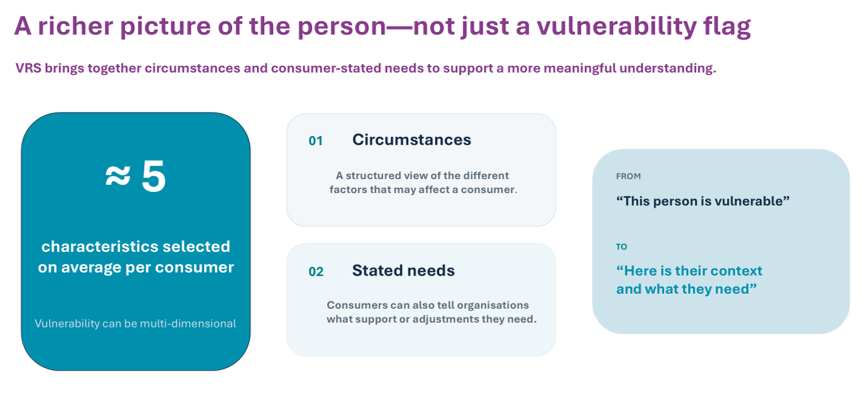
Vulnerability is rarely a single issue. Financial difficulty, mental or physical ill health, caring responsibilities and other life circumstances can overlap. When organisations have a more complete picture, they are better placed to recognise individual needs and respond appropriately.
The webinar considered how this approach can help move organisations towards a more connected model of support, reducing the need for people to repeatedly explain their circumstances and helping ensure important information is not missed.
Find out more about the webinar: https://lnkd.in/p/eshV899E
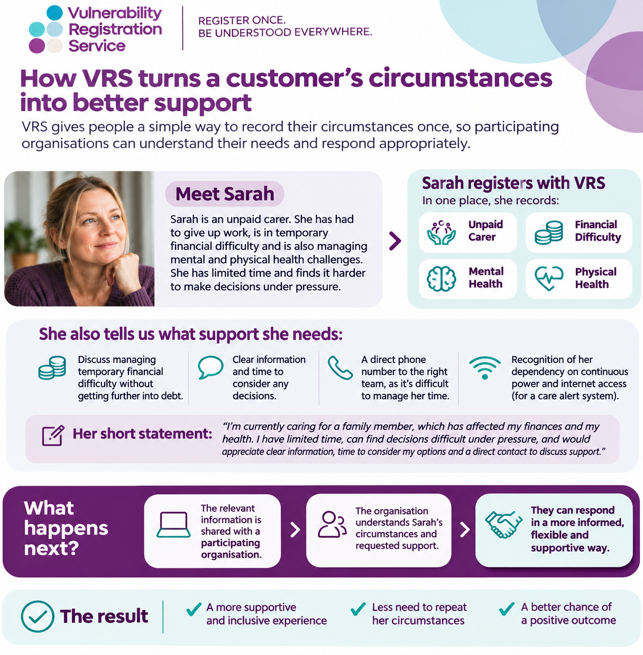
From personal circumstances to better support
A simple illustration of what a VRS registration can mean for a participating organisation.
Meet Sarah –a fictional example of an unpaid carer whose circumstances have affected her finances, health and ability to manage everyday interactions.
What don't you know about your customers or residents? The insight that VRS can provide
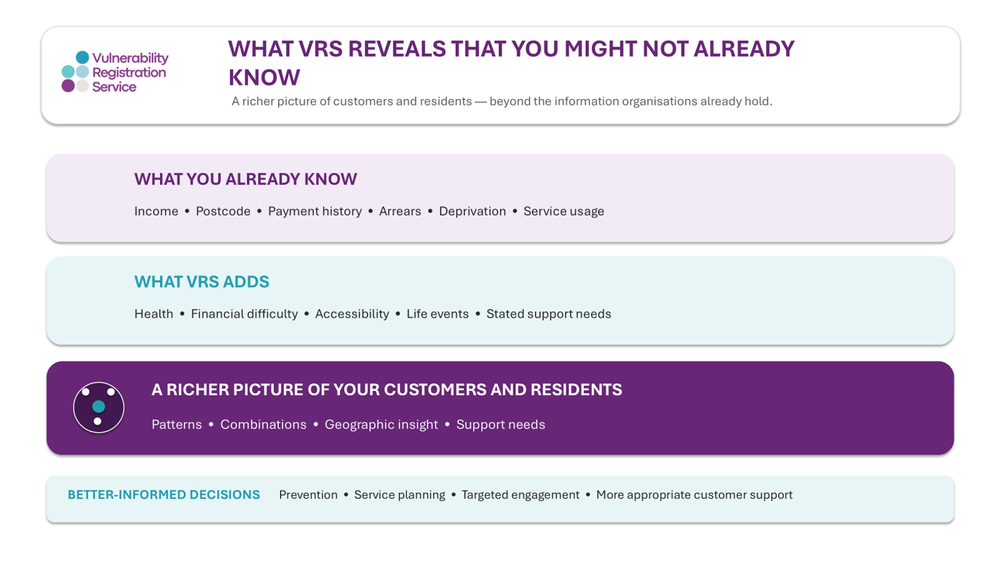
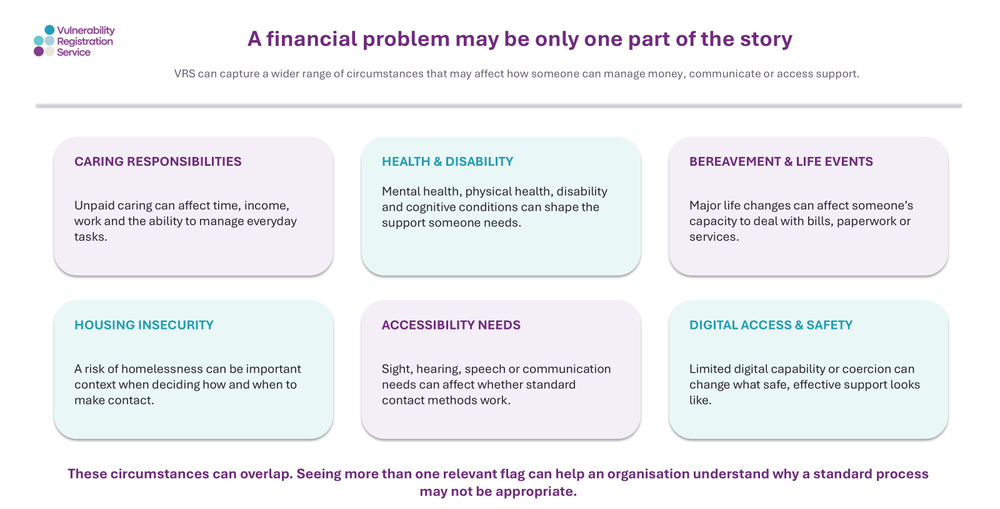
Vulnerability data can reveal much more than individual circumstances. It can help organisations understand the communities they serve, identify patterns of need and see issues that conventional data may overlook.
Most organisations have a considerable amount of information about their customers or residents. They know where people live, what services they use, what they pay, whether they have missed payments and, in some cases, whether they have accessed support.
Local authorities have access to deprivation indices, income data, housing information and other measures of socioeconomic need. Utilities understand consumption, payment patterns and arrears. Financial services organisations have detailed information about customers' financial circumstances and account activity.
But how much do these organisations really know about the wider circumstances affecting the people they serve?
Do they know who is experiencing economic abuse or who is an unpaid carer? How many are experiencing mental health difficulties alongside financial pressure? How many are struggling with a combination of circumstances that makes it difficult to engage with services? And, importantly, are these issues occurring in places where conventional data would lead them to expect them?
This is where the Vulnerability Registration Service (VRS) offers something different.
Looking beyond conventional measures
VRS has developed a cross-sector data model that allows individuals to register multiple characteristics of vulnerability and, importantly, to explain what support or outcomes they are seeking from the organisations they deal with.
The value is not simply in identifying that someone is experiencing vulnerability. It is in understanding the combination of circumstances, how those circumstances may interact and what they mean for the individual.
We recently undertook an analysis using a regional authority area as a case study, combining VRS vulnerability information with established socioeconomic data, including income, deprivation and formal financial distress indicators.
The exercise was designed to answer a relatively simple question:
What does VRS tell us that existing data might not?
The findings were particularly interesting.
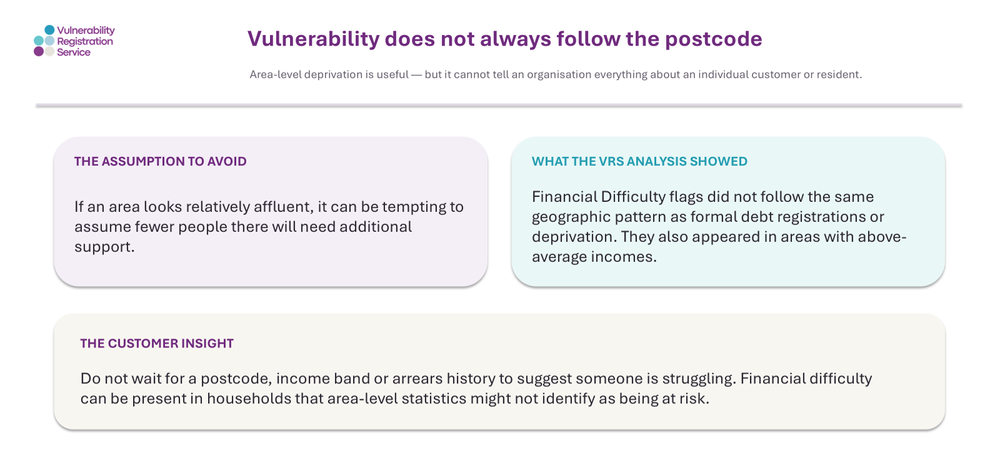
Financial difficulty doesn't always follow deprivation
One of the clearest findings was that the VRS Financial Difficulty flag did not follow the same pattern as conventional income and deprivation measures.
The analysis found that income and deprivation were very strongly correlated across the 17 districts examined (approximately 0.92). Formal debt-solution registrations also broadly followed the established socioeconomic pattern, with a reported correlation of approximately -0.81 against the income measure used. However, the relationship between income and the VRS Financial Difficulty flag was much weaker, at approximately -0.16.
In practical terms, this means that financial difficulty was appearing in places that might not necessarily be identified as high-need areas through conventional deprivation measures.
Some of the higher Financial Difficulty rates appeared in relatively affluent districts. This is a significant distinction.
A household does not necessarily experience financial difficulty because it lives in a deprived area. Someone may have a good income, a previously stable financial position and a comfortable home, but a change in circumstances can quickly alter their financial resilience.
Bereavement, illness, caring responsibilities, relationship breakdown, reduced working hours or an unexpected financial shock can all have a significant impact.
The message for organisations is that postcode, income and deprivation alone cannot tell the whole story.
Vulnerability is rarely just one thing
Another important insight is the extent to which different vulnerability characteristics can overlap.
An individual registering with VRS currently shares, on average, around five characteristics of vulnerability.
That is important because it demonstrates why treating vulnerability as a single category can be misleading. Consider some of the combinations that VRS can identify:
• Financial Difficulty alongside Mental Health and Physical Health flags.
• Unpaid Carer alongside Financial Difficulty, reflecting the impact of caring on employment and income.
• Risk of Homelessness alongside debt-related indicators and mental health difficulties.
• Cognitive Disorder or Limited Technological Capability alongside accessibility and communication requirements.
• Bereavement alongside financial difficulty and other significant life changes.
These combinations provide a much richer picture of the circumstances affecting individuals.
The regional analysis also demonstrated that different vulnerability characteristics have different geographic and demographic profiles.
One relatively affluent area, for example, had a comparatively low overall VRS registration rate, but a notable proportion of its registrants had formal debt-solution indicators and a comparatively high Mental Health rate.
This is precisely the sort of detail that can be lost when organisations look only at overall vulnerability numbers or broad measures of deprivation.
What could this tell your organisation?
For local and combined authorities
VRS can provide an additional layer of intelligence to help authorities understand the circumstances affecting residents across their areas.
It can help identify where financial difficulty exists outside traditionally deprived neighbourhoods, where unpaid caring responsibilities interact with health
and employment, and where housing insecurity may sit alongside debt and other vulnerabilities.
Combined with appropriate local datasets, such as council tax arrears, housing and rent arrears, adult social care and homelessness prevention information, this could support more targeted prevention, outreach, resource planning and service design.
It also creates opportunities to understand vulnerability at individual, household and neighbourhood levels, where appropriate data linkage and permissions exist.
For utilities
Understanding that a customer is experiencing financial difficulty is useful. Understanding that the same customer may also have a physical health condition, be an unpaid carer or have limited technological capability provides considerably more context.
This can help utilities consider how they communicate with customers, the accessibility of their services, appropriate support routes and how they respond to customers experiencing payment difficulties. It can also help identify patterns of vulnerability within customer populations that may not be apparent from consumption or payment data alone.
For financial services
VRS can help organisations understand the wider circumstances behind financial difficulty.
A customer struggling to meet repayments may also be experiencing bereavement, mental health difficulties, cognitive impairment or caring responsibilities.
These circumstances can affect decision-making, communication and the ability to engage with conventional customer journeys.
Understanding the wider picture can help organisations have better-informed conversations and consider more appropriate support.
For housing providers and other service organisations
The combination of financial difficulty, risk of homelessness, physical and mental health, disability and other life events can provide a more detailed picture of the pressures affecting individuals and households.
This can help inform earlier engagement, appropriate referrals and more joined-up support.
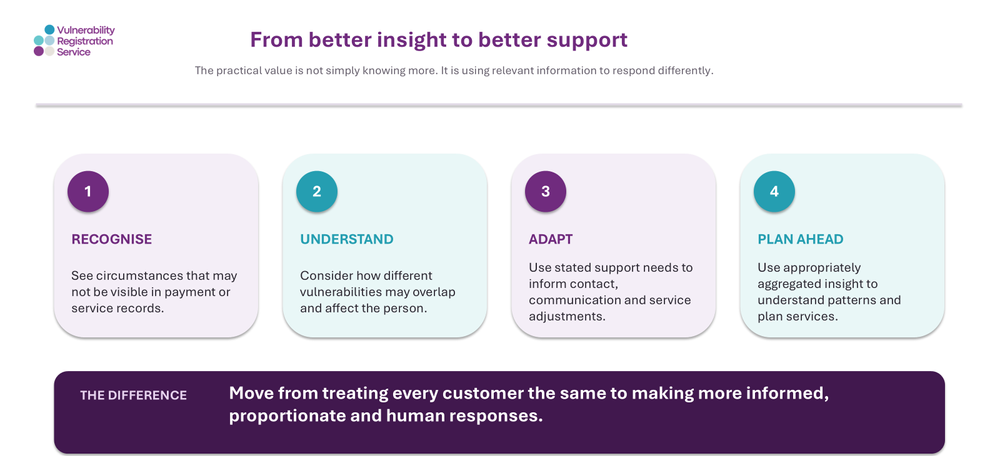
From identifying vulnerability to understanding what people need
There is another important distinction that makes VRS particularly valuable.
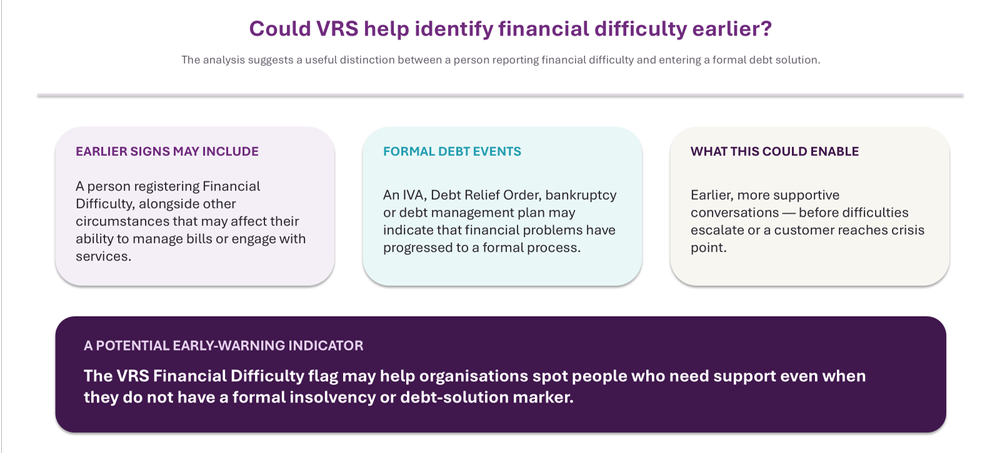
Individuals do not simply select vulnerability flags. They can also record the outcomes and support they would like from organisations.
For example, someone might explain that they are struggling financially, that their decision-making is affected, that they need additional time to consider decisions and that they require a direct telephone contact rather than having to navigate an online service.
This is incredibly useful information. It moves the conversation away from simply identifying a vulnerable customer towards understanding how an organisation can make its service work better for that person.
The analysis can also move beyond individual records. Aggregated VRS information can help organisations understand the geographic distribution of particular vulnerabilities, identify combinations of need and explore how these relate to existing socioeconomic indicators.
With appropriate partner datasets, there is further potential to examine relationships with employment, housing, benefits, arrears, health and service access.
The opportunity is already there
The regional case study demonstrates that VRS can contribute something genuinely different to the existing evidence base. It does not replace the data organisations already hold, nor does it replace their own assessments, responsibilities or professional judgement. It adds another dimension: a view of vulnerability based on people's actual circumstances and the support they say they need.
For organisations, the opportunity is to move beyond knowing who their customers are and start understanding what is happening in their lives.
For local authorities, that means a richer understanding of residents and communities.
For utilities, it means a better-informed understanding of customers and the challenges they may face.
For businesses across all sectors, it means the opportunity to identify patterns, understand emerging needs and make better-informed decisions about how services are delivered.
The question is no longer simply how many vulnerable customers or residents you have. It is what their circumstances are telling you, what you might otherwise be missing and what you can do with that insight.
VRS would welcome conversations with organisations interested in exploring what its data could reveal about their own customers, residents or communities info@the-vrs.com
Looking Ahead: VRS Conference 2027 and More to Come
Following the success of our May 2026 Conference, we're already looking ahead to next year!
We were absolutely delighted to welcome the 300 people who attended, participated, exhibited, presented, organised (Absolutely Admin) and sponsored the event. A huge thank you to everyone who helped make it such a success. The enthusiasm, expertise and commitment in the room made it a truly valuable occasion for everyone involved.
If you haven't had a chance to revisit the event, or missed it altogether, we still have a fantastic gallery of photographs, along with the video and podcast clips recorded on the day, available on our website:
Visit the VRS Conference Gallery
Please keep an eye on the https://www.linkedin.com/company/15237978 for announcements about dates and plans for our 2027 conference.
If your organisation would be interested in sponsoring or exhibiting at our next event, we'd love to hear from you. Please contact: Helen Lord – helen.lord@the-vrs.com or Nigel Bryant – nigel.bryant@the-vrs.com
And there's more to look forward to
And there's more to look forward to! Early next year, we'll also be holding a special event to launch the VRS Vulnerability Passport and Alerts Service – an important next step in our work to help people share their circumstances and receive more joined-up support.
More details will follow, so watch this space!
Listen to podcasts from:
•Alison Walters, Financial Conduct Authority
•Andrew Thomsen, Information Commissioner’s Office
•Jemma Baker, Ofgem
… and more with this link: https://www.vulnerabilityregistrationservice.co.uk/gallery
And because we thought they were so wonderful, here is a quick link to Vicky McClure’s Our Dementia Choir performing at the close of our conference. https://www.facebook.com/reel/2242850596564316
Vulnerability Registration Service Launches Consumer Portal Support Network
The Vulnerability Registration Service has launched a Support Network for vulnerable people to get help and support in one place
Individuals registering with the Vulnerability Registration Service identify with an average of five characteristics of vulnerability, ranging from financial difficulty to mental and physical health, accessibility issues and difficulties caused by life events
The Vulnerability Registration Service (VRS), the UK’s cross-sector, central database, alerting companies to customer vulnerability, has launched a support network to allow consumers to access help in one place.
This is the first phase in ensuring that people can access comprehensive and relevant help through one route, avoiding the need to trawl the internet to identify support channels when life is at its most challenging.
The sole purpose of the Vulnerability Registration Service is to allow vulnerable individuals to alert banks, utilities, government departments, housing, insurance and financial service providers to their circumstances, tell them what help they need, and enable organisations to provide a tailored and appropriate customer experience.
Helen Lord, CEO of the Vulnerability Registration Service said:
“It is difficult to use labels when it comes to why an individual is vulnerable – it is usually a complicated mix of mental and physical health, accessibility challenges, financial difficulty and life events, all combined with a dose of human emotion. People identify with an average of five characteristics of vulnerability when registering with VRS.
“We believe that people should be able to freely and easily find discounts, benefits and the help they need when they are possibly overwhelmed and struggling. Through our partnership collaborations, we are leading people to help that includes debt management and income and expenditure, identifying eligibility for benefits, specialist assistance for unpaid carers and linking to a host of support groups, all in one place”.
VRS has collaborated with strategic partners meaning that through the VRS Consumer Portal, consumers can:
• Access the National Support Network Support Hub providing an all-in-one vetted directory of national services
• Contact StepChange Debt Charity which provides free and non-judgemental debt advice, helping people take back control of their finances and their lives
• Through the Healthy Homes Solutions Vulnerability Initiative, find out what funding and support is available for home heating and powering homes, get assistance registering with energy providers’ Priority Service Register and benefit from their direct referral partners such as Cruse Bereavement, Alzheimer’s Society, Kidney Care, MS Society, Policy in Practice, Warm Wales and Independent Age
• Link to My Care Consultant, an award-winning, independent, service to help members of the public navigate a less stressful path to affordable and suitable care, working with many organisations throughout the UK, providing experts to support family carers or those in need of care themselves.
• Connect to IE Hub, which provides a secure, user-friendly platform for individuals to complete a Standard Financial Statement (SFS) compliant Income and Expenditure, in their own time, share it with creditors to avoid the need to repeat circumstances to multiple creditors
• Access money management for vulnerable individuals through Money Carer
• Identify eligibility for benefits, social tariffs and grants with the Inbest Benefits Calculator
VRS allows anyone to register for free so that the information can be shared with their service providers to act upon. Consumers can select from vulnerability flags to highlight how they are vulnerable – these flags include mental and physical health; financial difficulty and capacity; life events such as bereavement and providing unpaid care; accessibility issues ranging from hearing or sight impairment, dyslexia to technical capability.
Those who register can also use the service to communicate to service providers, how they can be helped e.g. their communication preferences or how they can be helped with financial management.
Cat Divers, Founder and CEO, National Support Network said:
“ When a customer registers their vulnerable circumstances, it is powerful to know that, in that very moment, they can be connected to trusted support to help them resolve or better manage their situation. We are proud to be working with VRS to extend their offering and help those in need.”
Derek Owen, Managing Director, Healthy Home Solutions said:
“At HHS our goal is simple: make it easier for people to get the right help, first time. Partnering with the VRS means residents don’t have to repeat their story – we can securely register their need once and ensure they’re prioritised and protected across our essential services partner network.”
Jacqueline Berry, Founder, My Care Consultant said:
“Families are having to navigate the plethora of ever complex rules and processes across the UK care systems, at a time when most are trying to address urgent needs, have no prior experience of doing so and are often in a state of stress and anxiety. My Care Hub enables us to make the extensive knowledge we have built up over time available to a far greater number of people. It provides valuable support for individuals, offering 24/7 access to much needed online information and guidance.”
Download: Press release – Vulnerability Registration Service Launches Consumer Portal Support Network
For more information or to arrange an interview with Helen Lord, please contact Simon Towers at simon.towers@the-vrs.com or info@the-vrs.com
For more information about our partners:
www.stepchange.org
www.mycareconsultant.co.uk
www.iehub.co.uk
www.moneycarer.org.uk
www.healthyhomesolutions.co.uk
www.nsn.org.uk
www.inbest.ai
Why Enforcement Needs to Embrace Shared Vulnerability Data
The Enforcement Conduct Board (ECB) is preparing to launch its Vulnerability and Ability to Pay Standards in January 2026. These Standards will require enforcement firms to embed a culture where identifying and responding to vulnerability comes first. From the VRS perspective, this is a welcome development – but we believe that data-sharing is essential if the Standards are to be effective in practice.
Why Vulnerability Data Matters in Enforcement
The ECB recognises that enforcement can create or compound harm if vulnerabilities go unidentified. People may experience:
Financial harm through escalating fees or loss of essential assets
Emotional harm such as stress, anxiety or stigma
Physical harm where conditions are worsened by hardship
Social harm, including family breakdown and isolation
The ECB expects enforcement to pause or cease altogether in limited cases of acute vulnerability. But to make those decisions fairly, firms need to know about people’s circumstances before they send an agent to the door.
How VRS Flags Can Help
At the Vulnerability Registration Service (VRS), we already work with creditors, utilities, debt advisers and others to ensure vulnerability is recognised early. Our system of flags provides a clear signal to enforcement firms when they need to adapt their approach.
Some of the most relevant of our 35 flags for enforcement include:
Mental Health Flag – alerting firms to risks of psychological harm or the need for sensitive communication
Severe or Long-Term Illness Flag – highlighting conditions that could be worsened by enforcement action
Financial Hardship Flag – showing where any additional costs could cause disproportionate harm
Domestic or Economic Abuse Flag – signalling situations where a standard visit could be unsafe or retraumatising
Risk of Homelessness Flag – identifying when an individual or household is at risk of losing their home, requiring a particularly careful response
Accessibility Flag – covering issues such as hearing or visual impairments, poor literacy, digital exclusion or language barriers that affect how people can engage
These flags are not only practical and easy for agents to use – they also give firms a consistent way to apply the ECB Standards in real-life situations. The VRS is already working with local authorities dealing with council tax, and we would encourage local authorities to share data with enforcement firms and their agents, as well as pro-actively act upon information fed back by the agents.
Beyond Flags: Guidance on What Action is Needed
Crucially, the VRS does more than simply flag a vulnerability. We also record what action the person registering wants organisations to take. This guidance means firms don’t just know that someone is vulnerable – they know how to respond appropriately.
In fact, our data shows that:
53% of actions requested are straightforward – people simply want organisations to use different communication channels or provide clearer explanations.
Other actions can include requests for breathing space, avoiding doorstep visits, or signposting to support.
By following these actions, enforcement companies can meet the ECB’s outcome-focused expectations while also reducing the risk of harm.
Supporting People Directly
Alongside data-sharing, the VRS consumer portal provides a support element that helps people build resilience and take control of their circumstances. We offer a range of self-help tools, including:
Guidance on eligibility for benefits
Access to discounts and social tariffs
Links to specialist advice services
This means that when people register with VRS, they don’t just make enforcement safer – they also gain access to practical support that can improve their long-term financial wellbeing.
Building a Safer Enforcement Process
The ECB’s ambition is for enforcement to become “safe by design.” To achieve this, firms need more than policies and training – they need reliable information, early in the process.
The VRS can help by:
Giving enforcement companies early sight of vulnerabilities
Advising on the right actions to take
Helping agents adjust their approach before contact is made
Supporting firms’ compliance with the ECB Standards and accreditation requirements
Providing consumers with ongoing support through our portal
Working Together
We know firms may be concerned about the cost and practicality of accessing vulnerability information. But shared services like the VRS are designed to make it simpler and more efficient. By pooling data, the whole sector benefits from better information, lower risk, and improved outcomes.
The ECB is clear: the enforcement industry must shift its culture on vulnerability. Shared vulnerability data – and the practical support that comes with it – is one of the most effective ways to make that shift real.
At the VRS, we look forward to working with enforcement companies to ensure that the new Standards not only deliver compliance, but also a fairer and safer enforcement process for the people who need it most.
Embedding the Consumer Duty

By Kevin Still
At the end of July 2025 a number of FCA directors reported on progress made in financial services since the Consumer Duty was implemented in July 2023. Alison Walters, Director of Consumer Finance, provided an update in which she looked at areas of progress under ‘creating better outcomes for people’, including around vulnerability management.
“The Duty required a fundamental shift in mindset, and two years on, we’ve seen real change across the sector – from lenders and credit brokers to debt collectors and debt advice providers.”
“This includes better identification of vulnerable customers where some firms now cross-check new customers against external vulnerability registers, helping them to ensure tailored support from day one.”
The Vulnerability Registration Service (VRS) is one of these external vulnerability registers that has been referenced by Alison at previous FCA events.
Many firms have redesigned consumer information and their websites to improve accessibility and intelligibility. The FCA has previously flagged challenges with low levels of literacy and numeracy, including English not first language. They are now looking at positive friction in customer digital onboarding journeys. API look-ups can be embedded in these journeys to identify recorded vulnerabilities on a ‘tell me once’ basis.
She has also referenced digital innovation, where firms like VRS have invested heavily in their digital offerings, providing online portals for customers to manage their accounts, and created solutions to help people check for additional benefits they may be entitled to with providers like InBest AI and Policy in Practice.
Improved partnership working has been crucial where VRS can signpost customers to debt advice or money health check services where needed, like StepChange Debt Charity, IE Hub or National Support Network (NSN).
VRS allows anyone to register for free so that the information can be shared with their service providers to act upon. Consumers can select from vulnerability flags to highlight how they are vulnerable – these flags include mental and physical health; financial difficulty and capacity; life events such as bereavement and providing unpaid care; accessibility issues ranging from hearing or sight impairment, dyslexia to technical capability.
Those who register can also use the service to communicate to service providers, how they can be helped e.g. their communication preferences or how they can be helped with financial management.
Cat Divers, Founder and CEO, National Support Network said:
“ When a customer registers their vulnerable circumstances, it is powerful to know that, in that very moment, they can be connected to trusted support to help them resolve or better manage their situation. We are proud to be working with VRS to extend their offering and help those in need.”
VRS supports a national water social tariff
By Kevin Still
Further to the recent government recommendations on improving outcomes to consumers by water providers, the Vulnerability Registration Service (VRS) supports the CCW and government recommendation around a national water tariff and support for those showing characteristics of vulnerability.
The “Cunliffe water social tariff” refers to the national social tariff for water bills proposed in the 2025 report by Sir Jon Cunliffe to reform the UK water industry, which aims to ensure more consistent and adequate support for vulnerable customers by creating one national tariff to replace the varying company-specific schemes, which are a postcode lottery. While this national tariff is a future proposal, many water companies currently offer their own social tariffs or financial assistance schemes to eligible customers with low household incomes. These vary dramatically from one provider to another.
The roadmap to rebuild trust in water sector unveiled in major new report in July 2025.
We fully support objectives:
To ensure a more consistent and fairer level of support for all vulnerable and low-income households across the country.
To improve consumer protection by establishing a clearer, national framework for assistance.
The VRS is consumer centric and designed to identify someone’s support needs, which are particularly relevant during a crisis or service outage. Energy outages often cause water service problems. Recent research from Independent Age has highlighted many elderly people cutting back on water usage. It is probable that the same people will be making cuts on energy usage and other essential expenditure. VRS has sub-flags for low financial resilience and a number of other relevant vulnerabilities, which will also align with the Priority Services Register (PSR) where this may be age and capability related, which often involves carers and support providers. VRS has partners with National Support Network (NSN), IE Hub (affordability assessments) and StepChange to provide a range of linked support services as part of its new consumer hub. All work closely with major water providers delivering services directly to consumers in a range of circumstances.
During the first half of 2025 the Independent Age polling found that 46% of older people on a low income reduced the amount of times they flush the toilet to reduce their water bill. 41% reduced how often they use the washing machine and 31% reduced how often they shower. Independent Age is also calling for a national social tariff for water which would mean people of all ages living on a low income would qualify for consistent financial support to lower their water bills. In 2024 the charity’s own research revealed that without intervention, the number of older people living in water poverty could rise from 750,000 to almost a million by 2029/30.
73% of older people in England and 72% in Wales, across all income levels, support the introduction of a single, standardized social tariff for water bills in England & Wales. It is probable that this is likely to be similar for families on low income with young children, notably those eligible for the PSR.
“There are 1.9m older people living in poverty in the UK. Many of them struggle with high household costs, preventing them from living in dignity and comfort in their later life. Older people are often hidden from discussions about experiences of financial hardship and about the solutions to poverty.”
The CCW advice hub is packed with information and useful tools to help consumers reduce their bills or access financial support, including advice on the different types of schemes that water companies provide.
https://www.ccw.org.uk/save-money-and-water/help-with-bills/
Helen Lord, CEO of VRS, recently published a Blog around improving data sharing amongst essential service providers.
“Ofwat states that 52% of households are likely to be eligible for extra support owing to circumstances that make them vulnerable.”
53% of vulnerable consumers identify communication as a challenge
More than half (53%) of people registering with the Vulnerability Registration Service (VRS) highlight communication needs as a primary challenge, according to new data released today. These needs span mental health, financial difficulty, and accessibility challenges — and addressing them effectively could save time, reduce harm, and build trust between consumers and service providers.
The findings underscore how simple miscommunication, or a lack of understanding can compound vulnerability, particularly when people are dealing with complicated credit agreements, pensions, insurance claims, or even paying everyday bills.
Helen Lord, CEO of the VRS, said:
“Miscommunication and a lack of understanding can compound vulnerability when we’re dealing with complicated credit agreements, pensions insurance claims or simply paying bills. Our data is saying that over 50% of people experiencing challenges would benefit from tailored communication and clearer explanations. At VRS we are giving a voice to vulnerable people to pinpoint these needs and therefore offering service providers the opportunity to address them.”
The VRS provides organisations with an independent, central register to identify and understand the needs of customers in vulnerable circumstances. Through a wide range of flags — covering financial difficulty, mental health conditions, bereavement, accessibility challenges and more — service providers can ensure they interact with customers in the most appropriate way. On average, consumers registering with VRS identify with 5 different characteristics of vulnerability.
Why it matters for businesses
•Time saving: Getting communication right first time reduces repeat contact and unnecessary disputes.
•Consumer protection: Clearer communication helps prevent the mis-selling of inappropriate products.
•Trust building: Tailoring communication to consumer needs fosters confidence and strengthens long-term relationships.
Helen Lord added:
“The way businesses communicate is not a ‘soft issue’ — it has real financial and reputational consequences. Understanding how to speak to customers in vulnerable circumstances benefits everyone: it reduces risk, saves time, and builds trust. Managing vulnerability is a complicated issue for businesses but communicating in the right way is a quick win for all.”
Vulnerability Registration Service launches new feature to help protect vulnerable unpaid carers in the UK
‘Overwhelmed and at the bottom of the priority list’ – unpaid carers face significant mental and financial challenges making them among those most as risk of becoming vulnerable, according to the VRS.
Organisations must take proactive steps to understand who among their customers are unpaid carers, so that they can be appropriately supported.
New VRS flag will help ensure that the specific circumstances of unpaid carers are taken into account by the organisations that serve them.
UK, 22 May 2024 – The Vulnerability Registration Service (VRS), a not-for-profit company providing the UK’s first central vulnerability database, has introduced a vital new feature to its service to help ensure support reaches the estimated 5.7 million unpaid carers in UK.
The VRS believes that unpaid carers are among those most at risk of being or becoming vulnerable, and it is vital that their circumstances are taken into account by the organisations that serve them – including banks, financial services, insurers, local government, utilities, mortgage and housing.
According to the charity Carers UK, which has been flagging the VRS to carers that are dealing with particularly challenging circumstances, unpaid carers save the UK £162bn a year. This figure, however, does not reflect the often severe economic and emotional challenges those individuals face. Previous VRS research has shown that two in five carers consider themselves vulnerable. Nearly one in four are struggling with their mental health, while more than one in five are in financial distress and finding it difficult to keep on top of their payments.
Thanks to VRS’ new flag, unpaid carers will be able to register with the VRS for free and highlight their specific circumstances to organisations. Organisations, meanwhile, can use the VRS to proactively identify who amongst their customers are unpaid carers, ensuring that they provide the most appropriate advice and support.
The service will also help connect carers to the specific support in terms of funding and low-cost services that are available to them – support that is not always easy to find, access and understand for stressed out and time poor unpaid carers.
Helen Lord, CEO of the Vulnerability Registration Service, said: “It’s not just the day-to-day care of another person’s health. Carers are also faced with trying to manage the financial affairs of the people they care for with providers that have data protection restraints in place, making it very difficult and time consuming for them to make any progress.
“Unpaid carers consistently find themselves at the bottom of the priority list and overwhelmed by the pressures they face. Many have had to give up jobs, impacting them financially. Those that manage to juggle a job with care commitments find themselves excluded from financial support, such as Carers Allowance.”
Working closely with other organisations to support unpaid carers, the VRS also hopes the new flag will enable them to easily connect unpaid carers to the financial support that is available to them.

Madeleine Starr MBE, Director of Carer Services at Carers UK, said: “Carers are making an enormous contribution to society, but many are at breaking point, facing challenges managing caring alongside their own health and wellbeing. They feel invisible and overlooked. It is crucial that they are seen and actively supported by their communities, by the government and by the organisations that service them. We welcome the VRS development and see it as a valuable step towards helping carers feel seen and more supported.”
Rachael Walker, Policy and Research Director at Policy in Practice, said: “Providing support to unpaid carers should be a national priority, and yet the system of financial support currently available is falling short. With more than £2.2 billion in unclaimed Carer’s Allowance, unpaid carers shore up our national health and social care services, and are often living in poverty and debt as a result. We owe it to carers to provide support when we can, and flagging their status through the VRS is a great step towards this.”
To introduce the new ‘unpaid carers’ flag and provide more details, the VRS is holding a webinar on June 7th – Care For Those Who Care – VRS Virtual Event.
Note to editor:
For more information or to speak to The Vulnerability Registration Service (VRS) please contact Serj Hallam at Nellie PR. Email: Tel: +44 (0) 7789 372 771 or Ellen Carroll at Nellie PR. Email: ellen@nelliepr.co.uk Tel: +44 (0) 1392 927746 Mob: +44 (0) 7790 631 547
About The Vulnerability Registration Service: www.vulnerabilityregistrationservice.co.uk/
We help financial services providers to identify and ensure the fair treatment of vulnerable customers – helping to reduce debt, financial problems and harm.
The Vulnerability Registration Service is a not-for-profit company providing the UK’s first central vulnerability database. Registering with the VRS is completely free for vulnerable customers and their representatives to help inform service providers of their vulnerable circumstances such as financial abuse, risk of fraud, over-indebtedness, impact of Covid and power of attorney. The Vulnerability Registration Service is used by service providers and other organisations to help them ensure vulnerable customers are treated fairly and appropriately, and that their current financial circumstances are taken into account.
Vulnerability Data Sharing in the UK: A VRS Perspective
This paper is intended to provide a high-level view on the status of vulnerability data sharing in the UK from a VRS perspective. It is based upon our learnings over the last nine years and our observations of how the vulnerability landscape has developed through our extensive interaction with regulators, charities, government and service providers across most sectors.
You can read it in full, below, or download it.
Vulnerability-Data-Sharing-in-the-UK-A-VRS-PerspectiveDownload
Vulnerable people can register for free with the Vulnerable Registration Service vulnerabilityregistrationservice.co.uk, a central, independent register of vulnerable people, that helps organisations to identify vulnerability and treat their customers fairly and appropriately.
Note to editors:
Helen Lord is available to be interviewed and provide comment about how vulnerable customers, in particular victims of financial abuse, can be better identified and supported, and the need for greater data sharing across industries to protect the most vulnerable people. For more information or to arrange an interview, please email info@the-vrs.com.
It’s so easy to access our data: through our API or our new Client Portal
You can now access VRS data three different ways:
Sign in to our online Portal and conduct an immediate Search on an Individual.
Upload a Bulk File to our Portal and perform Multiple Searches or Registrations at once.
Search or register via our API, integrating directly and efficiently into your IT system. This works best for companies with large volume or automation demands.
Request access to our Business Portal and API documentation, or email any queries, to info@the-vrs.com
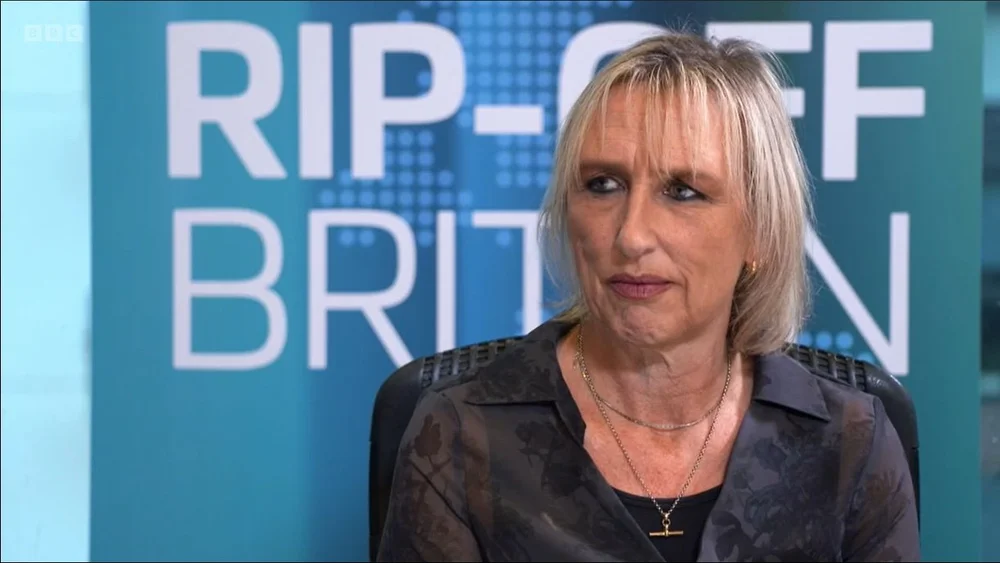
Rip Off Britain: Helen talks about the Priority Services Registers
This week Gloria asked Helen whether all energy companies are meeting their obligations to support their vulnerable customers, and how the PSR’s can be improved through increased awareness. You can watch Gloria and Helen through the BBC iPlayer.
Burnley Savings and Loans has joined the Vulnerability Registration Service
A new partnership between the Vulnerability Registration Service (VRS) and Burnley Savings and Loans – the company created by local business man David Fishwick, and made famous by the film Bank of Dave – will result in even more vulnerable people receiving the care and consideration they need.
Burnley Savings and Loans will now be able to search the VRS database to find out which of their existing or potential customers are vulnerable, and what their vulnerabilities are. They’ll be able to use this information to adapt their approach appropriately, and communicate with that person accordingly.
This new partnership will help protect vulnerable people, and ensure that they don’t have to have the same, often difficult, conversations.
Helen Lord, CEO of the Vulnerability Registration Service, said: “We are really proud to be able to work with such a forward thinking and innovative organisation. The VRS exists to help protect vulnerable people, and it’s great to know that people who have vulnerabilities such as dyslexia, poor levels of numeracy, physical disability and mental health issues, can be treated more carefully. Organisations like banks, utilities, mobile phone companies, local authorities and councils, have a duty to use this information and act in the best interests of people.
Dave Fishwick, Owner and Founder of Burnley Savings and Loans, said:
“Burnley Savings and Loans Ltd are pleased to be associated with the excellent Vulnerability Registration Service, who help protect vulnerable people. Burnley Savings and Loans Ltd are consumer centric, and as an ethical business, we believe we have a duty to act in the very best interests of our customers at all times.”
IE Hub: the ultimate solution to support customers managing their money effortlessly
When former teacher and career coach Helen was signed off work with ADHD, she thought that the reduction in income was something she just had to adjust to.
Helen had left teaching during the pandemic to pursue her own business in coaching, but when she noticed her concentration levels fluctuating, she knew something was not quite right. A diagnosis confirmed that ADHD would have an impact on her working and earning full time and she began to fall into arrears with many of her bills.
Sinking further into debt, she reached out to Citizens Advice for help, who then referred her to income and expenditure specialist IE Hub, which offers its customers a free online tool that allows them to create a budget at their own convenience and pace. Customers can easily see what money they have coming in and going out, and even identify areas where they could be overspending. The tool allows the customer full visibility of their financial situation and also enables them to pass on their income and expenditure details to creditors who they owe money to directly from their IE Hub account.
Speaking of her situation, Helen says:
“I’d always been on top of my finances and hated to see my financial situation getting worse because of my mental health condition. The IE Hub form helped me to gain clarity and to my surprise also highlighted some of the benefits I could be claiming. These included community support, a discretionary housing fund, care support for my son and household support.
It’s amazing how a simple form has helped me out and importantly has put me on the right track to moving back into credit. I feel like the future will be better for me now that I have taken control.”
Budgeting can be a daunting task for most of us, adding in the pressures of simultaneously communicating with multiple creditors about their situation and a lack of understanding of the financial support available to them, customers can become overwhelmed very quickly.
With 71% of customers reporting reduced anxiety as a result of using the tool, IE Hub is the ultimate solution to support customers managing their money effortlessly.
Providing customers with the ability to share their completed budget with any company they wish to, removing the need for long phone calls and repeating their information several times in order to make payment arrangements. All their financial information is conveniently stored in one place. If circumstances change, customers can easily update their information and share it again with the relevant companies.
Within IE Hub, customers also have access to an income maximisation tool, automatically being notified of the additional income they may be eligible to receive from benefits, social tariffs, discretionary payments and grants. 67% of customers found they were eligible to receive additional income of £435 per month on average thanks to IE Hub flagging this as part of the customer journey.
Partnering with the Vulnerability Registration Service (VRS) has allowed IE Hub to further enhance the support offered to customers. Providing a direct route for vulnerable customers to register for VRS to ensure they are known to the companies they are dealing with, supporting them to continue managing their finances independently moving forward. Our partnership also allows us to access the VRS database, identifying any IE Hub customers who are already registered with VRS, flagging this to the organisations they share their budget with.
IE Hub CEO, Dylan Jones, says: “At IE Hub, we understand the challenges faced by financially vulnerable customers like Helen. That’s why we’ve partnered with the Vulnerability Registration Service (VRS) to provide enhanced support. Through our collaboration, we offer a direct registration pathway for vulnerable customers, ensuring their needs are known and addressed by the companies they interact with. Moreover, our access to the VRS database enables us to identify and support IE Hub customers who are already registered, reinforcing their financial management journey. Together, IE Hub and VRS strive to empower individuals, helping them regain control of their finances and create a brighter future.”
IncomeMax: helping people claim the money they’re entitled to
As we enter the summer season and experience warmer weather in the UK, it might seem like the energy crisis is behind us and things are returning to normal. However, the reality is far from it for millions of households across the UK who continue to struggle financially.
The cost of living crisis has arrived straight after the Covid-19 pandemic and households are really feeling the strain.
Inflation, sky high energy costs, rocketing food bills, high rents and rising mortgages are becoming the norm. Millions of people are turning to food banks to survive.
It seems crazy to think that in the middle of a cost of living crisis £19 billion pounds of benefits and financial support is going unclaimed every year by UK households. It is an issue particularly affecting the most economically vulnerable members of society.
Since its establishment in 2009, IncomeMax has assisted over 130,000 individuals to claim what they are entitled to.
Vulnerable people within society have arguably faced a greater impact due to the cost-of-living crisis. Many of our customers who require help and support have been placed on pre-payment meters for their gas and electricity. Affordability or credit risk concerns often lead to this situation, leaving them with limited disposable income to cover essential costs and forcing them to make difficult decisions regarding what essentials they can and can’t afford.
IncomeMax has been providing assistance to these customers since 2009, but the current cost of living crisis has made life even more challenging for those who were already struggling. Fortunately, over the past 14 years, IncomeMax has managed to identify and secure over £38 million in additional income for the most financially vulnerable members of society. In the past 12 months, we have also formed a partnership with the Fuel Bank Foundation, allowing us to provide emergency pre-payment vouchers to individuals. These vouchers enable them to top up their pre-payment meters, ensuring they can have heating and lighting when they are unable to afford a top-up and would otherwise face self-disconnection.
Unfortunately, due to inflation and the recent energy crisis, we have observed a higher rate at which individuals in crisis consume emergency fuel vouchers for pre-payment meters. Additionally, the impact of the rising cost of weekly supermarket shopping and public transportation expenses on disposable income means that the support provided by the Fuel Bank Foundation doesn’t last as long as it has done in previous years. The same challenges exist for those who rely solely on benefit income, stretching what families must pay for despite the benefit rates increase in April 2023.
Nonetheless, IncomeMax remains committed to tirelessly seeking additional income for individuals and families. In the past 12 months alone, we have discovered new income sources for 88% of the customers referred to us by our partners, including Ovo Energy, EDF, Agility Eco, Utilita, StepChange Debt Charity, and Nationwide.
Our service involves identifying and assisting individuals in claiming benefits they may have overlooked due to the complexity of the system or simply being unaware of their entitlement. In the past year, we have successfully identified and confirmed payments over £8 million in new income for our customers. However, we are fully aware that there is more we can do.
At IncomeMax, the £19 billion in unclaimed means-tested benefits each year drives us on. It is a topic we continually address and discuss.
Should we, as a society, accept this situation every year without taking action? Should the system be simplified? What more needs to be done?
Interestingly, at IncomeMax, 84% of the individuals for whom we discover new income are already receiving some form of benefit income, indicating that they are slipping through the safety net designed to support them.
Could the £19 billion pounds of unclaimed income be re-allocated by Government to alternative methods of providing assistance to those who need it most?
IncomeMax, alongside other organisations in the income maximisation sector, intends to explore these questions in detail during our upcoming income maximisation event in July 23.
This event will be hosted in the House of Commons and aims to engage policymakers and Members of Parliament in a conversation about these very issues.
If you support our cause and would like to attend this event, please get in touch.
Kent County Council & VRS
The VRS are delighted to announce our partnership with Kent County Council. Kent are sharing their vulnerable client data with us to help protect their vulnerable residents. We have also signed up to their ‘ReferKent’ service so that other organisations that work with vulnerable people can be easily signpost them to the VRS. For more information – KCC partners with the Vulnerability Registration Service – News & Features – Kent County Council
The Energy Crisis is Far from Over
A blog by National Energy Action for the Vulnerability Registration Service.
The weather may be warmer and the media full of reports of energy prices coming down, but the energy crisis is far from over. There remains much to do to help households now and ahead of next winter, and even with the reductions in energy costs ahead, for millions energy will remain entirely unaffordable.
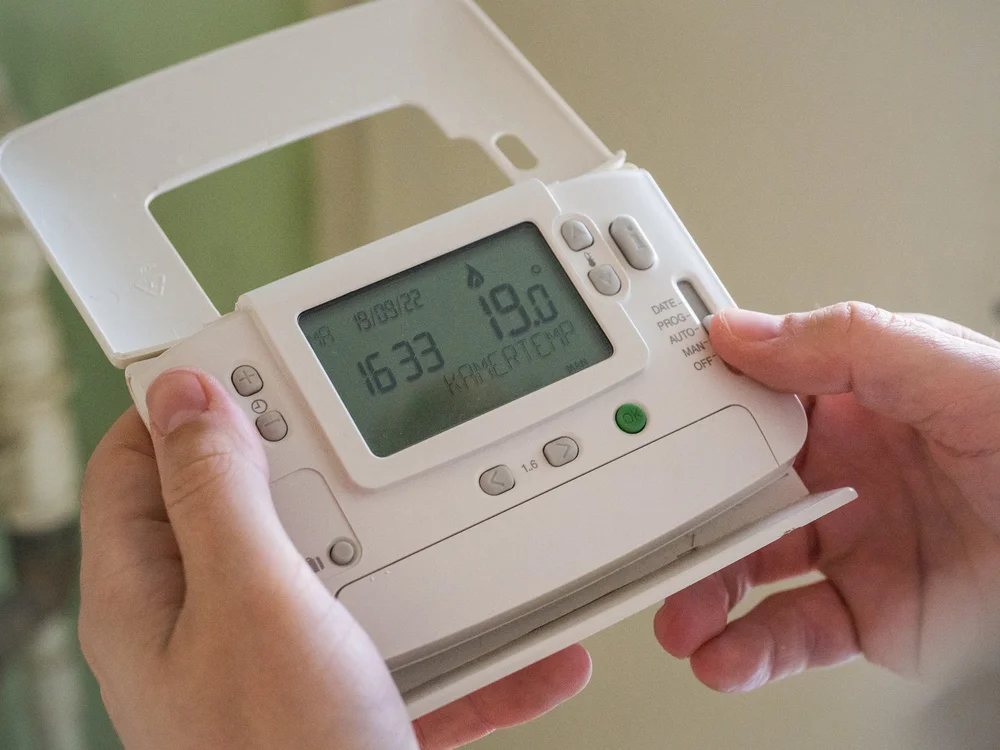
Ofgem announced on 25th May that the typical energy bill will fall to around £2,000 from 1st July. While this is welcome, this is still more than two thirds more expensive than in April 2021 (when the average bill was £1,138). At the same time, households have seen their finances eroded by the staggering cost of essentials, with low-income and the most vulnerable households hit hardest. The idea that we should be celebrating energy bills being at this level just two years later – while incomes remain stagnated – is unacceptable.
At National Energy Action we cannot accept high energy bills as the new normal and this is why we continue to campaign for fairer and more affordable energy market mechanisms and tariffs, as well as additional energy bill support from the government. We have several major concerns.
A debt crisis

While households will be using less heating in the coming months, they are likely to be heading into the next winter in very poor financial shape, unable to weather further storms. Regardless of the weather, debt is becoming a serious problem for fuel-poor households.
Analysis by Debt Justice in January found that total energy debt owed by households grew by 43% to £2.5 billion in the 12 months to October 2022. Those arrears will turn into formal debt repayment arrangements later this year. That will effectively make energy more expensive for those households in the winter to come.
Rationing and self-disconnection
One of the impacts of the energy crisis has been the rise in rationing energy use, whether for heating, cooking, or, in the most extreme examples, for medical equipment. There is little to suggest this will not be a similar situation faced by millions in the winter to come. As we have highlighted, for many households in fuel poverty, there is a dire need for them to use more, not less, energy to protect health and wellbeing.
In a call for evidence for National Energy Action’s 21-22 Fuel Poverty Monitor, respondents said households were:
• Avoiding use of central heating (if they have it) and using secondary appliances such as gas fires and plug-in electric radiators to minimise energy costs while concentrating as much heat as they can in one room.
• Going to bed to stay warm.
• Spending the day in heated spaces such as public transport, cafes, and A&E departments.
• Using candles for heat as well as light.
• Changing sleeping patterns to sleep during the day when it is warmer.
• Asking if their gas can be capped off to avoid using it (where households were living in social housing).
• Sending children to stay with relatives and friends to protect health when unable to access energy.
• Using unsafe, un-serviced, or inappropriate appliances to stay warm (61%). Burning furniture, flooring, and other items like clothes in open fires to try and keep warm (23%). Heating method such as these dramatically increase the risk of carbon monoxide poisoning.
Self-disconnection by prepayment meter customers (when they do not top up their meter) has also become a huge issue. Prepayment customers are disproportionately low income, with more than half having an income of less than £18,000/year. National Energy Action welcomed the introduction of the prepayment meter code of practice, even if still leaves uncertainty for some households. However, it is essential that this becomes part of the regulator Ofgem’s licence condition to prevent very vulnerable people from having these meters forcibly installed. We cannot be in a situation this winter when forced installs are happening again.
The impact of a cold home
For decades, the evidence has been clear: cold homes have a devastating impact on physical and mental health. Living in a cold home can cause and exacerbate various medical conditions, arising from living at a consistently low temperature and the growth of damp and mould. Research has consistently demonstrated the links between cold homes and health conditions, especially musculoskeletal, cardiovascular, and respiratory conditions, and poor mental health. For young children, for example, a cold home can mean poor school attainment and social exclusion, and have negative implications for their future life chances.
National Energy Action says that, based on modelling by the World Health Organisation, cold homes caused 4,020 excess winter deaths last year in England and Wales. That’s 45 people per day in winter months.
More must be done
Low-income and fuel-poor households are set to be in an especially precarious position come the next heating season. And with bills likely to remain at £2,000 this winter, and without the Energy Bills Support Scheme this time around, we will be heading into a new act in the energy crisis. This means another winter of cold homes, desperate coping tactics and suffocating debt. The government and regulator must work together to provide more support and protections for households, as well as pushing forward with energy efficiency.
Contact: Dr Danielle Butler, Senior Research and Policy Officer (danielle.butler@nea.org.uk)
Authors: Dr Danielle Butler, Nick Palmer